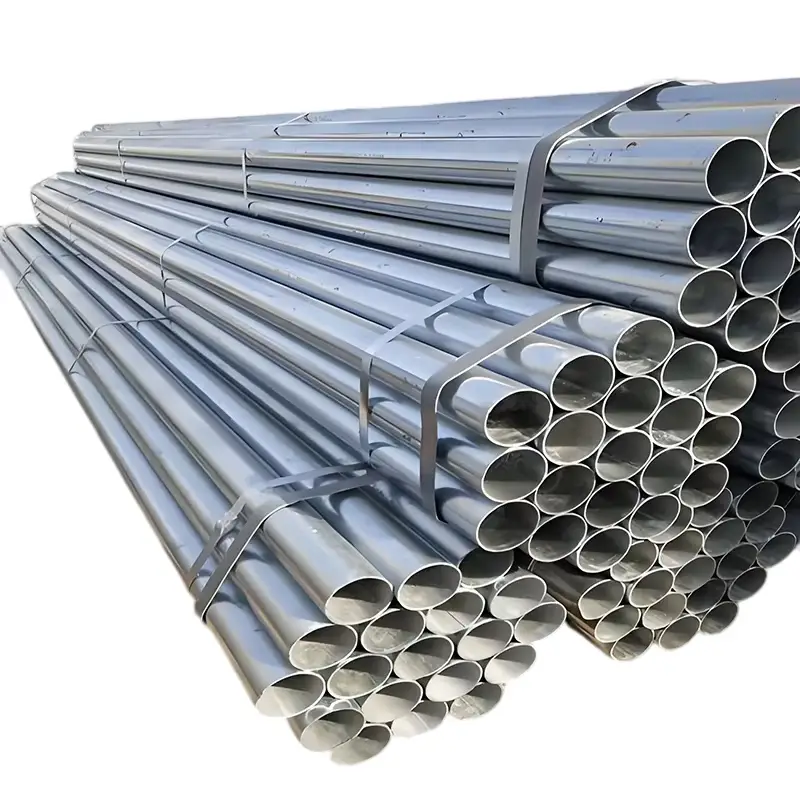
The scaffold tube weight per meter for a 48.3 mm tube is approximately 2.28 kg/m with a 2.0 mm wall, 3.56 kg/m with a 3.2 mm wall and 4.37 kg/m with a 4.0 mm wall. A 6 m 48.3 × 3.2 mm tube therefore weighs about 21.36 kg, while a 6 m 48.3 × 4.0 mm tube weighs about 26.22 kg.
These are theoretical bare-steel values. Actual delivered weight may differ because of dimensional tolerance, tube length, galvanizing and packaging. Buyers should confirm the weight basis before comparing quotations or raising a delivery claim.

48.3mm Weight Chart
This scaffold tube weight per meter chart uses a steel density of approximately 7,850 kg/m³.
| Outside Diameter | Wall Thickness | Theoretical Weight |
|---|---|---|
| 48.3 mm | 1.6 mm | 1.84 kg/m |
| 48.3 mm | 1.8 mm | 2.06 kg/m |
| 48.3 mm | 2.0 mm | 2.28 kg/m |
| 48.3 mm | 2.2 mm | 2.50 kg/m |
| 48.3 mm | 2.4 mm | 2.72 kg/m |
| 48.3 mm | 3.2 mm | 3.56 kg/m |
| 48.3 mm | 4.0 mm | 4.37 kg/m |
The values are rounded to two decimal places. BYTHAI product data also lists 3.56 kg/m for 48.3 × 3.2 mm tube and 4.37 kg/m for 48.3 × 4.0 mm tube.
Note on EN 39: EN 39:2001 is a historical reference for the 48.3 mm dimensions and nominal masses shown above. BSI lists BS EN 39:2001 as withdrawn. For new orders, buyers should specify the current product standard or project specification agreed with the supplier.
See BYTHAI’s scaffold tube product range for available dimensions, material grades and surface finishes.
Weight Formula
Round Steel Tube Formula
To calculate scaffold tube weight per meter, use:
Weight (kg/m) =
π ÷ 4 × [D² − (D − 2t)²] × 0.00785
Where:
D= outside diameter in millimetrest= wall thickness in millimetres0.00785= conversion factor based on a steel density of approximately 7,850 kg/m³
For routine purchasing calculations, the simplified formula is easier to use:
Weight (kg/m) = 0.02466 × t × (D − t)The result covers the steel tube body only. Zinc, paint, couplers, fittings, sleeves, end plates and packaging are not included.
48.3 × 2.0 mm Example
0.02466 × 2.0 × (48.3 − 2.0)
= approximately 2.284 kg/m
For normal quotation work, this is shown as 2.28 kg/m.
Using the rounded value for a 3 m piece:
2.28 × 3
= 6.84 kg
48.3 × 3.2 mm Example
0.02466 × 3.2 × (48.3 − 3.2)
= approximately 3.559 kg/m
Using the unrounded calculation:
3.5589 × 6
= approximately 21.35 kg/pc
For quotation and loading estimates, the rounded value is normally used:
3.56 × 6
= 21.36 kg/pc
Actual finished weight may vary because of dimensional tolerance, steel density, coating weight and manufacturing conditions. The purchase order should state whether acceptance is based on theoretical weight, quoted finished weight or measured delivery weight.
48.3 × 4.0 mm Example
0.02466 × 4.0 × (48.3 − 4.0)
= approximately 4.37 kg/m
For a 6 m piece:
4.37 × 6
= 26.22 kg
Weight by Length
Multiply the weight per metre by the tube length.
| Tube Size | Weight per Meter | Approx. 3m Weight | Approx. 6m Weight |
|---|---|---|---|
| 48.3 × 2.0 mm | 2.28 kg/m | 6.84 kg | 13.68 kg |
| 48.3 × 3.2 mm | 3.56 kg/m | 10.68 kg | 21.36 kg |
| 48.3 × 4.0 mm | 4.37 kg/m | 13.11 kg | 26.22 kg |
The table uses kg/m values rounded to two decimal places. Results calculated from the unrounded formula may differ by a few hundredths of a kilogram.
Scaffold Tube Weight Calculator
Calculator Example
Enter the outside diameter, wall thickness, tube length and quantity.
| Input | Value |
|---|---|
| Outside diameter | 48.3 mm |
| Wall thickness | 3.2 mm |
| Tube length | 6 m |
| Quantity | 1,000 pcs |
Weight per metre:
0.02466 × 3.2 × (48.3 − 3.2)
≈ 3.56 kg/m

Weight per piece:
3.56 × 6
≈ 21.36 kg

Total theoretical weight:
21.36 × 1,000
≈ 21,360 kg
≈ 21.36 metric tons
This is a theoretical bare-steel estimate. Coating, dimensional tolerance, fittings and packaging are not included.
For an online calculator, the four input fields should be editable and the result should show kg/m, kg per piece, total kilograms and total metric tons.
Wall-Thickness Tolerance

A size such as 48.3 × 2.0 mm describes nominal dimensions. It does not mean that every point along every tube will measure exactly 2.00 mm.
The purchase order should define:
- Outside-diameter tolerance
- Wall-thickness tolerance
- Length tolerance
- Minimum wall thickness, if required
- Sampling and measurement method
- Material grade
- Unit-weight basis
- Permitted weight tolerance
Around a 2.0 mm wall, a 0.1 mm change alters the theoretical weight by approximately 0.10–0.11 kg/m. Across 20,000 m, the difference is roughly 2.0–2.2 tonnes.
When two quotations use the same nominal size but show different unit weights, ask both suppliers to state the assumed wall thickness and weight basis. A lower price per piece may simply reflect less steel in each tube.
Galvanizing Weight
Galvanizing adds mass, but no fixed percentage applies to every scaffold tube.
The external surface area of a 48.3 mm tube is approximately:
π × 0.0483 × 1
= 0.152 m² per metre
Using 600 g/m² only as an example:
0.152 × 0.600
= approximately 0.091 kg/m
This is a calculation example, not a required coating mass for scaffold tubes. It also covers the external surface only.
ISO 1461:2022 specifies coating requirements and test methods for batch hot-dip galvanized fabricated steel articles. However, it excludes tube and pipe hot-dip galvanized in automatic continuous lines. The applicable standard and minimum coating therefore depend on the production process: batch HDG or continuous pre-galvanizing.
The BYTHAI quotations supplied for reference describe the tubes as HDG. Buyers should still confirm the agreed process, coating thickness or coating mass, and whether the quoted unit weight represents bare steel or the finished galvanized tube.
Delivery Audit
The scaffold tube weight per meter calculation provides a useful delivery check, but a difference from the shipping documents does not automatically mean that the material is incorrect.
Before making a weight claim, check:
- Tube specification
- Quantity received
- Actual tube length
- Measured wall thickness
- Galvanizing or coating condition
- Packaging weight
- Scale or weighbridge accuracy
- Whether the stated figure is net or gross weight
Simple Delivery Audit
Suppose the purchase order is:
1,000 pcs × 6 m × 48.3 × 3.2 mmThe estimated theoretical weight is:
1,000 × 6 × 3.56
= 21,360 kg
= 21.36 metric tons
If the shipping document is heavier, check whether it includes steel straps, bundles, pallets, protective packing or coating. If it is lighter, confirm the received quantity, actual length and measured wall thickness.
Agreeing the weighing and sampling method before shipment is much easier than resolving a weight dispute after the complete order has been unloaded.
Container Loading

For preliminary loading calculations, convert scaffold tube weight per meter into total product weight:
Total Product Weight =
Weight per Meter × Length × Quantity
For example, 1,000 pieces of 48.3 × 3.2 × 6,000 mm tube have a theoretical bare-steel weight of:
3.56 × 6 × 1,000
= 21,360 kg
= 21.36 metric tons
This is the theoretical product weight for 1,000 pieces, not a recommended loading quantity for one container.
The final loading quantity must be checked against:
- Finished weight per piece
- Verified container payload
- Container tare weight
- Bundle dimensions
- Steel straps and packing materials
- Cargo weight distribution
- Carrier and local transport restrictions
Steel tube bundles are dense, so payload is often the first constraint. Tube length and bundle dimensions can also affect the loading arrangement.
For an actual shipment, BYTHAI can calculate the proposed quantity per container after the tube specification, packing method and destination have been confirmed.
For more information, see Scaffolding Container Loading and Import Costs.
RFQ Requirements
A clear scaffold tube RFQ should include:
- Outside diameter
- Nominal and minimum wall thickness
- Tube length and length tolerance
- Material grade, such as Q235 or Q355
- Surface finish: black, painted, pre-galvanized or HDG
- Current product standard or project specification
- Unit-weight basis
- Dimensional and weight tolerances
- Quantity
- Bundle size and packing method
- Inspection and weighing procedure
- Required certificates
- Destination port or delivery location
For new orders, do not rely on EN 39:2001 alone because BSI lists BS EN 39:2001 as withdrawn. Confirm the current product standard or project specification with the supplier before production.
Need a quotation for a specific tube diameter, wall thickness or shipment quantity? Send BYTHAI the required dimensions, surface finish, quantity and destination. We can confirm the quoted unit weight, packing method and proposed loading arrangement.
Request a Scaffold Tube Quote from BYTHAI
FAQ
What does a 48.3 mm scaffold tube weigh?
The answer depends on wall thickness. Common theoretical values are 2.28 kg/m for a 2.0 mm wall, 3.56 kg/m for a 3.2 mm wall and 4.37 kg/m for a 4.0 mm wall.
How much does a 6m 48.3 mm scaffold tube weigh?
A 6 m 48.3 × 3.2 mm tube weighs approximately 21.36 kg. A 6 m 48.3 × 4.0 mm tube weighs approximately 26.22 kg.
Why is the quoted weight different from the theoretical weight?
The theoretical value uses nominal dimensions and a fixed steel density. Quoted or measured weight may reflect dimensional tolerance, actual length, galvanizing and manufacturing variation. Gross shipment weight also includes packaging.
Does galvanizing increase scaffold tube weight?
Yes. The increase depends on the coating process, coating mass and coated surface area. Batch hot-dip galvanizing and continuous pre-galvanizing should be checked against their applicable standards separately.
What should QA/QC check when the shipment arrives?
Check the tube diameter, wall thickness, length, quantity, coating and representative piece or bundle weights. Confirm whether the purchase order and shipping documents use theoretical, finished net or gross weight.
Can theoretical weight be used for final acceptance?
Only if the purchase order says so. Otherwise, acceptance should follow the agreed product standard, dimensional tolerances, sampling plan and weighing method.
External References
- BSI — BS EN 39:2001 Loose Steel Tubes for Tube-and-Coupler Scaffolds
- ISO — ISO 1461:2022
- Galvanizers Association — EN ISO 1461 Guidance
The calculations in this article are intended for quotation comparison, purchasing and preliminary loading estimates. They are not a substitute for structural calculations, certified product data or an agreed inspection procedure. Product acceptance must follow the applicable project specification, current product standard, local regulations, purchase contract and manufacturer documentation.