Scaffold tube sizes are normally specified by outside diameter (OD), wall thickness and finished length. In many EN/BS-oriented tube-and-coupler projects, 48.3 mm OD with a 3.2 mm or 4.0 mm wall is a common purchasing reference. A 6 m length is widely available, although the project specification must always take priority.
For reference, a 48.3 x 3.2 mm bare steel tube weighs approximately 3.56 kg/m, while a 48.3 x 4.0 mm tube weighs approximately 4.37 kg/m. Other dimensions, such as 48.6 x 2.4 mm, may be supplied for customer-specific projects, but the applicable standard and coupler compatibility must be confirmed before ordering.
When requesting a quotation, state the complete size as OD x wall thickness x finished length and include the material grade, dimensional tolerances, surface finish, compatible couplers, inspection requirements and packing method.
Scaffold Tube Size Quick Reference
| Purchasing item | Typical reference | What to confirm before ordering |
|---|---|---|
| Common tube diameter | 48.3 mm OD in many EN/BS-oriented projects | Project specification and approved coupler range |
| Frequently specified walls | 3.2 mm or 4.0 mm | Whether the requirement is nominal or minimum wall, plus permitted tolerance |
| Customer-specified example | 48.6 x 2.4 mm | Applicable standard and approved couplers |
| Common stock length | 6,000 mm | Finished-length tolerance |
| 48.3 x 3.2 mm theoretical weight | 3.56 kg/m; approximately 21.35 kg per 6 m tube | Actual dimensions, coating and weighing method |
| 48.3 x 4.0 mm theoretical weight | 4.37 kg/m; approximately 26.22 kg per 6 m tube | Actual dimensions, coating and weighing method |
| 48.6 x 2.4 mm theoretical weight | 2.73 kg/m; approximately 16.4 kg per 6 m tube | Customer specification and actual weighing method |
| Commercial unit | Price per piece | Packing, documents, Incoterm and delivery terms |
What Is the Standard Scaffold Tube Size?
For tube-and-coupler scaffolding in many EN/BS-oriented markets, 48.3 mm OD is the most familiar reference diameter. Tubes with 3.2 mm and 4.0 mm walls are frequently specified, and 6,000 mm is a common stock length.
The sizes 48.3 x 3.2 mm and 48.3 x 4.0 mm are established references associated with EN 39 and the former Type 3 and Type 4 designations. However, BS EN 39:2001 is listed by BSI as withdrawn from 21 May 2026. A withdrawn standard may still appear in historical specifications, but it is no longer current. New orders should follow the latest project specification and the standards currently accepted by the designer, client and local authority.
There is no single scaffold tube size that is automatically suitable for every project. Tube dimensions must be selected together with the scaffold design, material properties, corrosion allowance, connection system and required load performance.
How to Read Scaffold Tube Dimensions
Scaffold tube dimensions are usually written in this order:
OD x wall thickness x length
For example:
48.3 x 3.2 x 6,000 mm
This means:
- 48.3 mm: outside diameter
- 3.2 mm: nominal wall thickness
- 6,000 mm: finished tube length
The inside diameter is not normally used as the primary purchasing dimension. It can be estimated as:
Inside diameter = outside diameter – (2 x wall thickness)
For a 48.3 x 3.2 mm tube, the theoretical inside diameter is 41.9 mm.
An RFQ should also state the permitted OD tolerance, wall-thickness tolerance or minimum wall, and finished-length tolerance. Do not assume that tolerances from an old order will apply to a new project.
48.3 mm vs. 48.6 mm Scaffold Tube
Both 48.3 mm and 48.6 mm outside diameters may appear in international scaffold-related purchasing, but they are not automatically interchangeable.

| Item | 48.3 mm tube | 48.6 mm tube |
|---|---|---|
| Typical purchasing context | EN/BS-oriented tube-and-coupler projects | JIS-oriented or customer-specified projects |
| Example wall thickness | 3.2 or 4.0 mm | 2.4 mm when specifically requested |
| Example theoretical 6 m weight | 21.35 kg at 3.2 mm; 26.22 kg at 4.0 mm | Approximately 16.4 kg at 2.4 mm |
| Coupler requirement | Must match the approved tube and coupler range | Must match the approved tube and coupler range |
A 48.6 x 2.4 mm tube should be described as a customer-specified or market-specific size unless the applicable specification explicitly defines it. JIS G 3444 covers carbon steel tubes for general structural purposes, including scaffolding applications, but the dimensional table in the applicable edition must be checked. Do not assume that every 48.6 mm tube or every wall thickness is a standard JIS scaffold tube size.
The 0.3 mm difference between 48.3 mm and 48.6 mm may look minor, but connection performance depends on more than diameter alone. Confirm the tube OD, wall thickness, coupler dimensions, approved combination and tested connection requirements before purchasing or mixing components.
Scaffold Tube Wall Thickness
Depending on the tube diameter, manufacturing process and customer specification, mills may offer walls such as 1.5, 1.8, 2.0, 2.4, 3.0, 3.2 and 4.0 mm. Manufacturing availability does not mean that every option is suitable for load-bearing scaffolding.
For purchasing comparisons, 48.3 x 3.2 mm and 48.3 x 4.0 mm are useful reference sizes. Final selection must follow the scaffold design and applicable specification.
Quality control should cover:
- Outside diameter
- Nominal or minimum wall thickness
- Length and straightness
- Weld condition
- End condition
- Surface finish and coating
- Tube weight, where required
- Heat or batch identification
- Material and inspection certificates
When comparing prices, check whether suppliers are quoting to the same wall-tolerance basis. A lower price may reflect a different minimum wall, steel grade, coating thickness, document package, packing method or delivery term rather than a like-for-like saving.
Learn more about our steel tube quality-control process.
Common Scaffold Tube Lengths
Six metres is a common stock length, but scaffold tubes can also be supplied in project-specific lengths when production capability, order quantity and transport conditions allow.
Always state the finished length and permitted tolerance. Writing only “6 m” can leave the cut-length tolerance unclear.
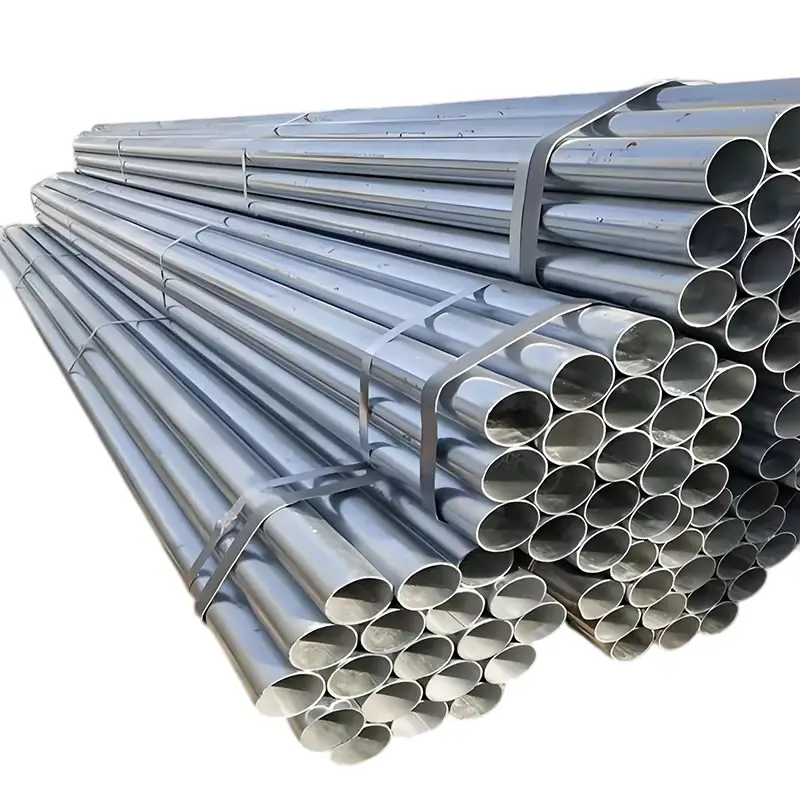
For packing reference, one BYTHAI configuration uses 61 tubes per hexagonal steel-strap bundle. Based on theoretical bare-steel weight, a bundle of 6 m tubes would weigh approximately:
- 1.30 tonnes for 48.3 x 3.2 mm
- 1.60 tonnes for 48.3 x 4.0 mm
This is a BYTHAI packing example, not an industry-standard bundle quantity. Before shipment, confirm the number of tubes per bundle, actual bundle weight, lifting method, storage limits and container-loading plan.
Scaffold Tube Size and Weight Chart
The theoretical bare-steel weight of a round tube can be estimated using a steel density of approximately 7,850 kg/m³:
Weight (kg/m) = 0.02466 x (OD – wall thickness) x wall thickness
OD and wall thickness are entered in millimetres.
| Outside diameter | Wall thickness | Theoretical weight | Theoretical weight per 6 m tube | Purchasing description |
|---|---|---|---|---|
| 38.0 mm | 4.0 mm | 3.35 kg/m | 20.12 kg | Project-specific size |
| 42.3 mm | 2.0 mm | 1.99 kg/m | 11.93 kg | Project-specific size |
| 48.3 mm | 3.2 mm | 3.56 kg/m | 21.35 kg | Frequently specified reference |
| 48.3 mm | 4.0 mm | 4.37 kg/m | 26.22 kg | Higher-wall reference |
| 48.6 mm | 2.4 mm | 2.73 kg/m | Approximately 16.4 kg | Customer-specified example |
| 60.3 mm | 3.0 mm | 4.24 kg/m | 25.43 kg | Bespoke size requiring matched fittings |
These values are estimates for bare steel based on exact nominal dimensions. Actual delivered weight may vary because of OD and wall tolerances, weld profile, coating, cut length and the agreed weighing method. Use measured batch data when finalizing a commercial quotation.
As a practical check, 60.3 x 3.0 mm tube has a theoretical bare-steel weight of approximately 4.24 kg/m. A datasheet showing around 2.88 kg/m for the same dimensions should be verified before quotation, as that weight would indicate a substantially thinner wall or a data error.
See our scaffold tube weight per metre guide for more calculation examples.
Steel Grades and Surface Finishes
Depending on the market and project, an order may specify grades such as Q235 or Q355B under the applicable Chinese standard, or STK400 or STK500 under the applicable JIS requirements.
Commercial comparisons between Q235, S235 and STK400 should not be treated as official material equivalence. Specify the required grade and standard together with the required mechanical properties, chemical composition, manufacturing route and certificate type.
| Surface finish | What to specify in the purchase order |
|---|---|
| Black | Corrosion allowance, storage and maintenance requirements |
| Painted | Surface preparation, paint system, dry-film thickness and repair method |
| Pre-galvanized | Coating requirement, weld-seam treatment and cut-end protection |
| Hot-dip galvanized after fabrication | Galvanizing process, coating requirement, inspection and repair criteria |
ISO 1461:2022 specifies requirements and test methods for hot-dip galvanized coatings applied to fabricated iron and steel articles. Its scope excludes tube and pipe hot-dip galvanized in automatic plants. The coating standard must therefore be selected according to the actual manufacturing and galvanizing process rather than assumed from the phrase “galvanized tube.”
How to Choose the Right Scaffold Tube Size

Use a scaffold tube size chart as an RFQ starting point, not as a substitute for structural design.
| Project scenario | RFQ starting point | Confirm before purchase |
|---|---|---|
| General tube-and-coupler scaffolding | 48.3 x 3.2 mm | Project standard, minimum wall and coupler compatibility |
| Higher-wall requirement | 48.3 x 4.0 mm where specified | Design loads, service conditions, handling and corrosion requirements |
| JIS-oriented project | Applicable JIS size | Current JIS requirements and approved couplers |
| Customer-specified 48.6 mm tube | 48.6 x 2.4 mm where specified | Customer specification, applicable standard and coupler compatibility |
| Bespoke application | Project-defined OD and wall | Drawings, design loads, tolerances and fitting compatibility |
Before confirming an order, check five items together:
- Applicable project and product standards
- Tube OD, wall basis and dimensional tolerances
- Material grade and required test certificates
- Coupler compatibility and connection performance
- Surface treatment, inspection and service environment
What to Include in a Scaffold Tube RFQ
A complete RFQ helps suppliers quote the same technical and commercial scope. The following example can be adapted for a project:
Product: Loose steel scaffold tube
Size: 48.3 x 3.2 x 6,000 mm (OD x nominal wall x finished length)
Dimensional tolerances: As required by the approved project specification
Material grade: [Insert grade]
Material standard: [Insert current applicable standard]
Surface finish: Hot-dip galvanized after fabrication
Coating requirement: [Insert requirement and applicable standard]
Inspection documents: [Dimensional report / material certificate / coating report]
Tube marking: [Required marking / heat number / batch identification]
Testing: [Applicable tests / third-party inspection]
Quantity: 1,220 pieces; quote price per piece
Packing: 61 pieces per bundle, subject to confirmation; state actual bundle weight
Destination: [Port and country]
Incoterm: [FOB / CIF / other]
For export orders, also confirm whether the quoted price includes packing, loading, inspection, certificates, export documentation and any other agreed deliverables.
Send BYTHAI your completed specification to receive a scaffold tube quotation based on the required size, quantity, coating and delivery term.
Frequently Asked Questions
What scaffold tube sizes are frequently specified?
In many EN/BS-oriented tube-and-coupler projects, 48.3 mm OD with a 3.2 mm or 4.0 mm wall is frequently specified. Other sizes may be required by the project, national standard or customer specification.
Is 48.3 mm the outside diameter of a scaffold tube?
Yes. The 48.3 mm dimension is the outside diameter. The inside diameter changes with the wall thickness.
What is the standard scaffold tube length?
Six metres is a common stock length, but it is not universal. Tubes may be supplied in other finished lengths when production and project requirements allow. Always include the required finished length and tolerance in the RFQ.
How is scaffold tube weight calculated?
For theoretical bare-steel weight in kg/m, use 0.02466 x (OD – wall thickness) x wall thickness, with all dimensions in millimetres. Multiply the result by the finished length in metres to estimate the weight per tube.
Can scaffold tubes be cut to a project length?
Yes. Specify the finished length, length tolerance, end condition and any coating-repair requirement when requesting a quotation.
Can tubes and couplers from different standards be mixed?
Only when the tube dimensions, coupler specification and connection performance have been verified for the intended application. Never assume that 48.3 mm and 48.6 mm tubes are interchangeable.
What information is required when buying scaffold tubes?
Provide the OD, wall thickness, finished length, wall and dimensional tolerances, material grade, applicable standard, surface finish, quantity, marking, testing and inspection requirements, certificates, packing, destination and Incoterm. A complete specification makes quotations easier to compare and reduces the risk of misunderstandings before production.
Request a Scaffold Tube Quotation
For an accurate per-piece quotation, send us the required OD x wall thickness x finished length, material grade, surface finish, quantity, destination and applicable standard. BYTHAI can review the manufacturing and packing requirements before confirming the commercial offer.