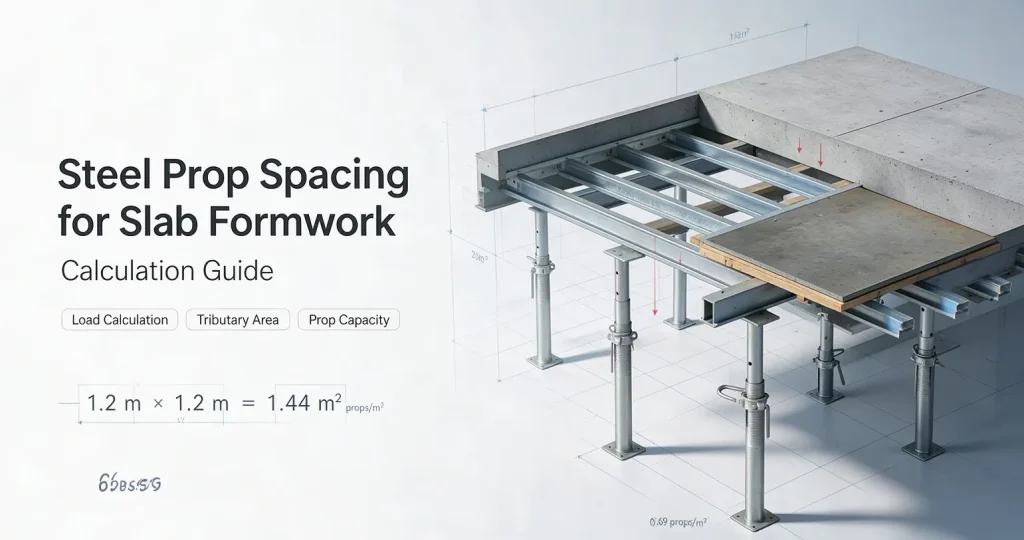
When selecting an adjustable prop, the colour and product name tell you very little. The useful details are the tube diameter, wall thickness, steel grade, working height and resistance at that height.
The current Bythai product sheet lists Q235 and Q355B steel, tube diameters from 40 mm to 89 mm, wall thicknesses from 1.6 mm to 2.4 mm, three duty descriptions and five surface options. It does not show model-specific extension or kN resistance figures. Those figures must come from the drawing or test report for the exact prop being quoted.

What EN 1065 Covers
EN 1065 is the European standard for adjustable telescopic steel props used as temporary supports. It covers product specifications, design assessment, calculation, testing and marking.
It is not a universal load table. A reference to the standard does not tell you the capacity of every prop in a supplier’s catalogue.
The national version may carry a prefix, such as BS EN 1065 in the United Kingdom. You can check the current record in the BSI standards catalogue. Access to the complete standard may require a licence.
EN 1065 Steel Props: Class A to Class E and What the Class Means
EN 1065 uses five class designations: A, B, C, D and E. The class is one part of the technical identification of a prop. It must be read with the model number, extension range and supporting resistance data.
There is no reliable “Class A = X kN, Class B = Y kN” shortcut for this article. The Bythai sheet supplied here does not identify an EN 1065 class or give a class-to-capacity table. The letters belong in the product record, while the load value must come from the exact model and extension being assessed.
| EN 1065 class | What to write in the RFQ | What must accompany it |
|---|---|---|
| Class A | Exact class and prop model | Model drawing and extension-specific resistance table |
| Class B | Class, tube configuration and working range | Material details and test or calculation reference |
| Class C | Class, closed height and required height | Resistance at the requested extension |
| Class D | Class and end-plate configuration | Current model report and marking details |
| Class E | Class, model and intended application | Design basis, test evidence and traceability record |
This is a purchasing reference, not an official EN 1065 classification table. The class letter alone does not give a project-approved working load. A quotation that only says “Class C” or “heavy duty” is incomplete for a temporary-works decision.
Class, Duty Description and Model
Bythai’s sheet uses the commercial descriptions light duty, middle duty and heavy duty. These descriptions help buyers navigate the range. They are not, by themselves, an EN 1065 class or a verified working load.
Put the exact model, class and height range into the purchase order. That matters when several prop sizes are packed in the same shipment.
Bythai Steel Prop Parameters from the Current Product Sheet
The following values are visible in the product information you supplied.
| Parameter | Bythai options shown in the sheet |
|---|---|
| Materials | Q235, Q355B |
| Tube diameters | 40 mm, 48 mm, 56 mm, 60 mm, 76 mm, 89 mm |
| Wall thicknesses | 1.6 mm, 1.8 mm, 2.0 mm, 2.2 mm, 2.4 mm |
| Duty descriptions | Light duty, middle duty, heavy duty |
| Surface treatment | Painted, powder coated, electro-galvanized, pre-galvanized, hot-dip galvanized |
These are genuine range parameters. They are not a capacity table. The same tube diameter can be used in different configurations, and a thicker wall does not automatically give a project-approved load rating.

EN 1065 Steel Prop Extension Ranges and Load Capacity
One important gap remains: the supplied sheet does not state closed height, maximum extension, intermediate extension points or resistance in kN. Those figures should stay out of the article until they come from the relevant Bythai drawing or report.
Until the model report is added, show the data status plainly:
| Bythai model | Closed height | Working range | Resistance at required height | Maximum-extension resistance | Current source |
|---|---|---|---|---|---|
| Light-duty prop | Not listed | Not listed | Not listed | Not listed | Bythai product sheet, p.14 |
| Middle-duty prop | Not listed | Not listed | Not listed | Not listed | Bythai product sheet, p.14 |
| Heavy-duty prop | Not listed | Not listed | Not listed | Not listed | Bythai product sheet, p.14 |
Once the inner tube is opened, the unsupported length increases. Alignment, end restraint and load eccentricity also affect performance. A figure measured near the closed position should not be used for a prop installed close to maximum extension.
What the Load Figure Means
Your paperwork may state characteristic resistance, design resistance, permissible load or safe working load. These terms can use different assumptions and safety factors.
The report should define the value, the test arrangement and the extension at which it applies. The project engineer then uses the correct figure for the approved temporary-works design.
How to Compare EN 1065 Steel Props Before Ordering
Tube Construction
Begin with the inner and outer tubes. Record the diameter, wall thickness, steel grade, overlap and straightness tolerance. The Bythai ranges help match a requested specification, but the final model still needs a drawing.
Adjustment Parts
Look at the collar nut, thread, handle and pin. These parts are used every time the prop is installed. Include the thread detail, pin arrangement and replacement-part availability in the purchase file.
End Plates and Welds
End plates transfer force into the supported structure. Their dimensions, thickness, flatness and weld connection belong on the product drawing.
Ask how the factory checks plate deformation, tube alignment, weld appearance, thread condition and pin fit. Those details are more useful than a general “heavy-duty” claim.
Surface Finish
Choose the finish according to the storage and site environment. The Bythai range includes painted, powder-coated, electro-galvanized, pre-galvanized and hot-dip galvanized options.
State the finish in the RFQ. “Anti-rust treatment” is too vague for a purchase specification.
For handling and storage after delivery, see Bythai’s steel shoring prop maintenance guide.
Documents to Include with the Quotation
A complete quotation pack normally includes:
- Product drawing and revision number
- EN 1065 class and model identification
- Closed height and maximum extension
- Extension-specific resistance table
- Tube diameter, wall thickness and steel grade
- End-plate and adjustment-part details
- Material certificate
- Dimensional and weld inspection records
- Surface-finish specification
- Marking and traceability method
- Net and gross packing weights
For U.S. formwork and shoring work, OSHA 29 CFR 1926.703 requires formwork and shoring to be designed, fabricated, erected, supported, braced and maintained so they can support the loads imposed on them. It does not certify an EN 1065 prop or provide a universal prop capacity.
UK teams can consult the HSE formwork and falsework guidance. The project design and local rules remain controlling.

RFQ Checklist for Steel Props
Include:
- Required closed and extended heights
- Design load or approved prop schedule
- Quantity by model
- EN 1065 class, if required
- Tube diameter and wall thickness
- Steel grade
- End-plate dimensions
- Pin and nut arrangement
- Surface finish
- Test, calculation and inspection documents
- Bundle quantity and destination port
No load schedule yet? Send the slab, beam and formwork information to a temporary-works engineer before choosing a model.
You can also compare the broader product range in How to Select Adjustable Steel Props.
Need an EN 1065 Steel Prop Quote?
Send Bythai the required height range, quantity, tube specification, finish and destination port. If you have an existing prop drawing or schedule, attach it.
We can match the request with the available Q235 or Q355B configurations and provide the relevant drawing and inspection documents. Numerical resistance values will be supplied against the exact model and test basis, not copied from a general catalogue description.
FAQ
How should I specify EN 1065 steel props in an RFQ?
State the required class, exact model, closed and extended heights, design load, tube specification, end-plate details, surface finish and document requirements. Include a drawing or existing sample when the new props must match equipment already on site.
What are EN 1065 prop classes?
The standard uses Class A, B, C, D and E designations. The class must be read together with the exact model, extension range and supporting resistance documents.
Does a larger tube diameter automatically mean a higher capacity?
No. Capacity also depends on wall thickness, steel grade, length, end conditions, alignment, connection details and the assessment method.
Why is the load at maximum extension important?
The prop is more slender when extended. The relevant figure is the verified resistance at the height where the prop will actually work.
Are light-, middle- and heavy-duty props EN 1065 classes?
Not automatically. Those are commercial duty descriptions in the Bythai range. The order should state the exact model and any required EN 1065 class.
What data is still missing from the current Bythai sheet?
The sheet shows materials, tube diameters, wall thicknesses, duty descriptions and surface treatments. It does not show closed heights, extension ranges, EN 1065 class markings or kN resistance values. Those items should come from the model drawing or test report.
Disclaimer
This article is for product comparison and purchasing discussions. It is not a shoring design, load table or approval for site use. A qualified temporary-works designer must verify the final prop selection and layout against project loads, extension, end restraint, local regulations, manufacturer instructions and current supporting documents.